
Archive for the 'Security' Category
Wednesday, July 27th, 2011
So we have already looked at all 3 possible NAT configurations, however there is one more trick that is always useful to know. How to overload a Static NAT. Let’s assume the following for this example We have 2 public IP addresses (192.168.1.1 & 192.168.1.2) The IP address on the outside interface has been configured [...]
Posted in Access-Lists, CCNA (ICND2), IINS, Internet, Routing, Security, SNRS | No Comments »
Friday, July 15th, 2011
In my last post Configuring Static NAT on Cisco Routers we saw how you can translate 1 IP address into another single IP address. This tutorial will cover how to translate many IP addresses into many IP addresses, otherwise referred to as many-to-many translation. Dynamic NAT allows us to translate many IP addresses into a [...]
Posted in Access-Lists, CCNA (ICND2), IINS, Internet, Security, SND | No Comments »
Monday, September 21st, 2009
NAT or Network Address Translation is a key function required in every organisations network. Since all organisation use RFC 1918 IP addressing, and these IP addresses are not allowed to exist on the internet, before we send packets to the internet we need to translate the internal IP address into a useable public IP address. [...]
Posted in CCNA (ICND2), Management, Routing, Security, WAN | 2 Comments »
Friday, August 21st, 2009
TCP SYN flooding is often used in conjunction with IP spoofing. The main aim of a TCP SYN flood is to send a TCP SYN packet to a host inside your network from a spoofed IP address. The TCP SYN ACK is then sent to a machine that is not expecting one, or a machine [...]
Posted in Access-Lists, Intrusion Prevention, IPS, ISCW, Security | No Comments »
Thursday, August 20th, 2009
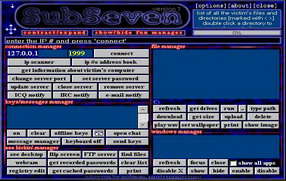
SubSeven – aka: Sub7 and Sub7Server is a backdoor program, in the form of a Trojan, used mostly for causing trouble on computer networks. It can be used for simple attacks such as hiding the mouse cursor and opening applications, but it can also be used for more serious attacks including retrieving all your personal [...]
Posted in Access-Lists, IINS, Intrusion Prevention, ISCW, Security, SND | No Comments »
Wednesday, August 19th, 2009
The big difference between the enable password and the enable secret is the encryption level. The enable password by default is saved in clear text so when looking at the running-configuration of the router you will be able to read the password. It is possible to encrypt this password using the service password-encryption command. [...]
Posted in IINS, IPS, Security, SND, SNRS | No Comments »
Tuesday, August 18th, 2009
Before looking at how to mitigate a Smurf attack, let’s first understand what it is and why it’s such a problem. A Smurf works on a weakness of IP and ICMP by sending an ICMP packet to the broadcast address of a network. For example, I could send an ICMP (Ping packet) to every [...]
Posted in Access-Lists, IINS, Intrusion Prevention, ISCW, Security, SND | 2 Comments »
Monday, August 17th, 2009
IP spoofing is the act of camouflaging your IP address to make it look like you are someone else. Although IP spoofing is not an attack by itself, it is the starting point of many of the most common attacks found on today’s networks. Most, but not all, of the spoofing attacks that take [...]
Posted in Access-Lists, IINS, Intrusion Prevention, ISCW, Security, SND | 3 Comments »
Friday, August 14th, 2009
One of the first and most important things to configure on any Cisco device after allowing telnet or SSH, is to restrict who is allowed to access the device. Of course having a password on the lines is the first step but if telnet is the method of communication, all passwords will be sent over [...]
Posted in Access-Lists, CCNA (ICND2), IINS, Security, SND, SNRS | No Comments »
Thursday, August 13th, 2009
Before looking into the configuration of ACL (Access Control Lists), it’s important to get some of the concepts and understanding of how they work and what they are used for. Firstly, most people believe that ACL’s are used purely for denying or allowing traffic, although this is certainly one of the functions of a ACL [...]
Posted in Access-Lists, CCNA (ICND2), Networking 101, Security | No Comments »