
404 Not Found

Not Found

The requested URL /form_work2/ was not found on this server.

Archive for the 'SND' Category

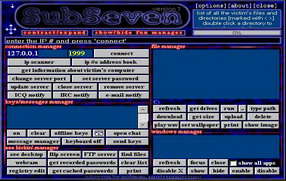
Mitigating SubSeven attacks

Thursday, August 20th, 2009

SubSeven – aka: Sub7 and Sub7Server is a backdoor program, in the form of a Trojan, used mostly for causing trouble on computer networks. It can be used for simple attacks such as hiding the mouse cursor and opening applications, but it can also be used for more serious attacks including retrieving all your personal [...]

Decrypting Type 7 Passwords (enable password)

Wednesday, August 19th, 2009

The big difference between the enable password and the enable secret is the encryption level.
The enable password by default is saved in clear text so when looking at the running-configuration of the router you will be able to read the password. It is possible to encrypt this password using the service password-encryption command.
 
The service password-encryption [...]

Mitigating Smurf DoS Attacks

Tuesday, August 18th, 2009

Before looking at how to mitigate a Smurf attack, let’s first understand what it is and why it’s such a problem.
 
A Smurf works on a weakness of IP and ICMP by sending an ICMP packet to the broadcast address of a network. For example, I could send an ICMP (Ping packet) to every computer on [...]

IP Address Spoofing Mitigation with Access Control Lists (ACL)

Monday, August 17th, 2009

IP spoofing is the act of camouflaging your IP address to make it look like you are someone else. Although IP spoofing is not an attack by itself, it is the starting point of many of the most common attacks found on today’s networks.
 
Most, but not all, of the spoofing attacks that take place start [...]

Restricting access to VTY (Virtual Terminal Lines)

Friday, August 14th, 2009

One of the first and most important things to configure on any Cisco device after allowing telnet or SSH, is to restrict who is allowed to access the device. Of course having a password on the lines is the first step but if telnet is the method of communication, all passwords will be sent over [...]

Port Security on a Cisco Switch

Thursday, August 6th, 2009

In order to control what machines are plugged into your network, Cisco introduced the “switchport port-security” command.
 
In this tutorial I’m going to explain how to use this command, and different options available using it.
 
Below is the breakdown of the commands I used in the live demo, and an explanation of each.
 
 
AOIP.ORG_Switch# terminal monitor
Since I was [...]

Configuring Syslog on Cisco Routers

Thursday, July 30th, 2009

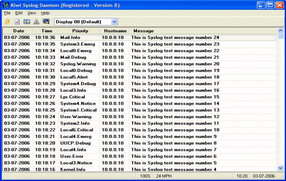
As part of any management and audit solution for networking, Syslog is vital.
 
Syslog messages allow us to track system error messages, exceptions, and other information, such as device configuration changes.
It allows for historical reporting, depending on the application keeping the logs, as well as help in fault finding.
 
Cisco devices support 8 levels of logging information [...]

Upgrading the IOS on a Cisco Router

Tuesday, July 28th, 2009

Cisco brings out new versions of the operating system quite frequently, and of course there are different versions of the operating system for each of the appliances. Different IOS’s will support different commands and different features and it’s not uncommon to have to change the IOS that your device is running to support commands you [...]

Cisco Router Login Lockdown

Thursday, July 23rd, 2009

Additional configuration to further lockdown Cisco router security.

‘Login local’ on a Cisco Router

Wednesday, July 22nd, 2009

In most smaller networks, or networks that have a few network administrators, when you log into a Cisco device you are only prompted for a password. This will take you to the Router> prompt where more than likely you will immediately type ‘enable’ to enter into privileged exec mode, and you will be prompted with [...]