
404 Not Found

Not Found

The requested URL /form_work2/ was not found on this server.

Archive for the 'Course Content' Category

NAT (Network Address Translation)

Monday, September 21st, 2009

NAT or Network Address Translation is a key function required in every organisations network.
Since all organisation use RFC 1918 IP addressing, and these IP addresses are not allowed to exist on the internet, before we send packets to the internet we need to translate the internal IP address into a useable public IP address.
There are [...]

Creating Layer 2 and Layer 3 Ether Channels

Friday, August 28th, 2009

In order to bundle multiple interfaces between switches in an effort in increase throughput, a Ether Channel can be created.
 
Ether Channels can be created as Layer 2 or Layer3. The obvious difference between the 2 is that a Layer 3 link will have a IP address associated and hence traffic can be routed between the 2 [...]

ISDN and Multilink with load-threshold

Thursday, August 27th, 2009

ISDN is a fantastic option as a backup in cases where your primary link has failed. However often your primary line has much more bandwidth than a single ISDN line (Channel). The ISDN BRI B-Channels run at 56kb/s or 64 kb/s (depending on country) and although this is a good start, often you need more [...]

Floating Static Routes

Wednesday, August 26th, 2009

In order to have a fully fault tolerant network, a backup solution for WAN links is vital. There are many options for configuring a backup line incase the primary line fails and in this tutorial we are going to look at using floating static routes to achieve a dial-up connection to act as our backup [...]

Configuring Basic ISDN with Interesting Traffic

Tuesday, August 25th, 2009

When configuring ISDN with interesting traffic, it’s important to first understand how Cisco defines ‘interesting’ and what this means in terms of the connection been formed. Interesting traffic is traffic that we define in the form of an access-list that is allowed to cause the ISDN to dial. This does NOT mean it is the [...]

ISDN Switch-type

Monday, August 24th, 2009

In order for any ISDN lines to establish Layer-1 connectivity the switch-type has to be defined correctly.
The switch-type is very much country dependant so it’s also important to memorize the switch-type that applies to where you do most of your installations.
 
If Layer-1 is showing ‘Deactivated’ when using the show isdn status command, only 3 things [...]

DoS TCP SYN Attack Mitigation

Friday, August 21st, 2009

TCP SYN flooding is often used in conjunction with IP spoofing.
The main aim of a TCP SYN flood is to send a TCP SYN packet to a host inside your network from a spoofed IP address. The TCP SYN ACK is then sent to a machine that is not expecting one, or a machine that [...]

Mitigating SubSeven attacks

Thursday, August 20th, 2009

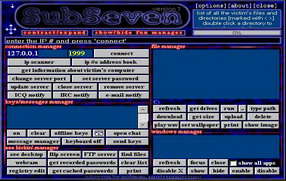
SubSeven – aka: Sub7 and Sub7Server is a backdoor program, in the form of a Trojan, used mostly for causing trouble on computer networks. It can be used for simple attacks such as hiding the mouse cursor and opening applications, but it can also be used for more serious attacks including retrieving all your personal [...]

Decrypting Type 7 Passwords (enable password)

Wednesday, August 19th, 2009

The big difference between the enable password and the enable secret is the encryption level.
The enable password by default is saved in clear text so when looking at the running-configuration of the router you will be able to read the password. It is possible to encrypt this password using the service password-encryption command.
 
The service password-encryption [...]

Mitigating Smurf DoS Attacks

Tuesday, August 18th, 2009

Before looking at how to mitigate a Smurf attack, let’s first understand what it is and why it’s such a problem.
 
A Smurf works on a weakness of IP and ICMP by sending an ICMP packet to the broadcast address of a network. For example, I could send an ICMP (Ping packet) to every computer on [...]